WORDPRESS
IndexNow Enabled but No URLs Submitted: Find the Missing Trigger
IndexNow is enabled in WordPress but shows zero submissions? Check eligible updates, plugin triggers, noindex rules, request evidence and actual API responses.
FREE WORDPRESS PLUGIN
IndexNow Health Check
Check diagnostic IndexNow key access, response status, and public URL signals before changing your submission setup.
- Install the diagnostic plugin
- Inspect key route and site visibility
- Run an explicit test if appropriate
Diagnostic only: it does not auto-submit URLs or guarantee indexing. The WordPress.org listing retains the original plugin URL.
You enabled IndexNow in WordPress, published a page, and still see zero submissions—or no new entry in your SEO plugin’s IndexNow history. That is a specific diagnostic problem, not yet proof that the API rejected anything. First ask: Was a qualifying URL-change event generated after activation, and was the URL eligible under this particular plugin’s rules? An enabled feature, an empty counter, a failed HTTP request, and a page missing from Bing search are four different observations.
Start here: identify your active IndexNow sender and version, check its automatic-submission settings, find one eligible change made after it was enabled, and look for an actual submission attempt. Only then investigate a key, network or API response. ModelGain IndexNow Health Check provides an optional independent check of the public IndexNow setup. It does not submit your site’s existing posts automatically or prove that another plugin’s publishing hook ran.
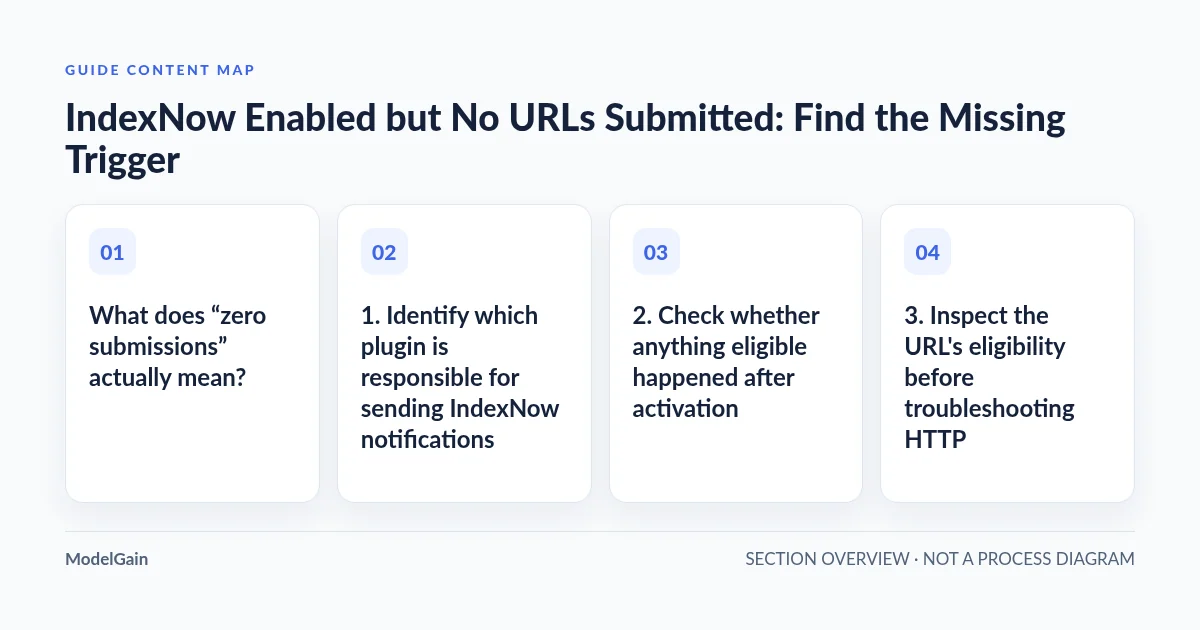
What does “zero submissions” actually mean?
| What you observe | Last proven stage | What to check next |
|---|---|---|
| IndexNow setting says Enabled, but history is empty | Configuration intent | Supported content event, post type, SEO exclusions, and whether an eligible change occurred after activation |
| The WordPress plugin shows 0 Submissions / 0 Failures | Its displayed counter | Reporting scope and retention; consult the sender’s own history and version before inferring no HTTP attempt |
| History contains HTTP 403 | An attempted request that was rejected | IndexNow key, host, key location and the precise failing endpoint—not automatic-submission activation |
| History contains HTTP 202 | URL received; key verification pending | Public key validation and the protocol’s later response, not a missing trigger |
| History contains HTTP 200 | The IndexNow endpoint received the notification | Search engine URL inspection, crawling and indexing eligibility—not the submit switch |
| No record in Bing Webmaster Tools | A reporting observation | Report scope, verified property, available data window and submission-side evidence |
A real WordPress.org reviewer described the exact problem in March 2026: 0 submissions, 0 failures after believing URLs had been sent. That is evidence of a user-reported symptom, not a verified root cause. The official Bing IndexNow WordPress plugin also says its dashboard retains only a limited recent list (20 successful and 20 failed URL entries); that view is not a lifetime audit of every network request. Record the actual time window before treating absence as failure.
1. Identify which plugin is responsible for sending IndexNow notifications
WordPress has several distinct IndexNow integrations. An SEO plugin being installed does not automatically prove its specific IndexNow feature is enabled, licensed or configured for the content type you published. Avoid installing another sender just to make a counter move; adding a second sender can complicate attribution and may generate duplicate notifications.
| Sender | Verified configuration or evidence surface | Specific caution |
|---|---|---|
| Rank Math SEO | Rank Math SEO → Dashboard → Instant Indexing module; Instant Indexing → Settings (automatic post types); Instant Indexing → History (response codes) | Some controls require Advanced Mode. Its documented auto-submit applies to selected types and published/modified content, not every admin edit. |
| Official IndexNow Plugin (Bing Webmaster team) | Its own IndexNow configuration, automatic-submission toggle, recent successes/failures and optional manual submission | The current plugin checks public noindex evidence and supports exclusion patterns; history is bounded, not a complete server trace. |
| Yoast SEO | Site features → IndexNow | Current official documentation labels the feature Premium. Do not assume the free edition offers the same native IndexNow switch. |
| AIOSEO IndexNow addon | The applicable licensed addon and its own installed version/configuration | Trigger handling can change between releases; check the vendor changelog and the installed addon, especially for scheduled posts. |
| Hosting or custom automation | Host-provided IndexNow task, logs or owner-approved integration | A host-level sender may have no corresponding WordPress plugin history entry. |
For exact product screens, consult Rank Math’s IndexNow setup and History guide, the Bing plugin’s current feature list, Yoast’s Site Features documentation and AIOSEO’s IndexNow addon changelog. If you find multiple active senders, identify their respective ownership, keys and targets before disabling or replacing anything; two installed plugins does not automatically mean two active network senders or an indexing penalty.
2. Check whether anything eligible happened after activation
Turning on an IndexNow integration does not universally notify search engines about every page you have ever published. A plugin may watch only selected WordPress post status transitions, specific post types, meaningful edits, or approved deletes. An old public article that predates activation may never have produced a new publish event. A preview, draft autosave, theme stylesheet change or page-builder template edit may also bypass the configured sender’s trigger; the exact behavior depends on the plugin and the type of change.
- Record the activation time and timezone, plugin/version/edition, configured automatic-submission state and eligible post types.
- Choose one existing public, self-canonical URL in a supported post type that you are permitted to update. Do not use a private, staging, checkout or customer-data URL.
- Find its last actual publish/update time. If no qualifying event happened after activation, the zero counter can be expected; do not invent an event by editing dozens of pages.
- Check whether the plugin distinguishes automatic submission from manual submission or a one-time test. A successful manual send does not establish that the automatic publishing hook works.
- Before performing a new change, inspect the sender’s existing history, errors, queues or documented logs, then ask the administrator for authorization for a single meaningful publication/update if a real trigger is still needed.
AIOSEO’s published addon changelog is a concrete example of why version specificity matters: it records a fix on August 20, 2026 (1.0.15) for scheduled-post publication notifications, and a November 3, 2026 (1.0.16) change to avoid notifying non-public types/taxonomies. These releases do not establish what another plugin or an unverified installation does; record the installed addon version and reproduce the relevant event before declaring a version bug.
3. Inspect the URL’s eligibility before troubleshooting HTTP
Some senders deliberately skip URLs they should not advertise to search engines. Check the final public URL, not only what a green SEO indicator or WordPress status badge says. For an eligible test page, verify its final HTTP status, canonical destination, robots meta tag, X-Robots-Tag headers, public/private status, post type and plugin-specific exclusion patterns. A sitewide Settings → Reading → Discourage search engines setting may also suppress submissions in implementations that honor it.
The official Bing IndexNow plugin documents automatic noindex detection from rendered HTML, response headers and site-wide visibility, plus configurable excluded paths. Rank Math likewise documents skipping URLs marked NoIndex. This is sender behavior, not a universal rule that the IndexNow protocol rejects every noindex page or that a missing submission should make you remove a legitimate privacy restriction.
Check our WordPress search visibility and IndexNow guide for the full sitewide setting, and use the received-but-not-indexed guide only when a request is known to have reached the IndexNow endpoint. If the page is intentionally excluded, stop: turning it into a public indexable page just to create an IndexNow submission is the wrong fix.
4. Run one controlled, attributable publishing test
Prefer an existing eligible event and its logs. If none exists, have the authorized site owner schedule one legitimate content update to a known public URL that the sender is documented to handle. Make the update for a real editorial reason, not to manufacture frequent fake freshness. Note the exact canonical URL, time in UTC, sender name/version, changed post type and expected trigger. Avoid exposing confidential paths, WordPress auth cookies or plugin keys in a public issue.
| Checkpoint | Evidence that advances the investigation | If absent |
|---|---|---|
| A. Trigger | Actual supported publish/update/delete transition after activation | Revisit event type, plugin settings, and the real WordPress save path |
| B. Eligibility | URL is public, allowed by sender’s post-type/noindex/exclusion rules | Keep intended exclusions; choose another permitted test URL |
| C. Dispatch | Plugin history, queue evidence or reliable outbound request log | Inspect the plugin’s trigger/job path; absence of a log alone is not proof no request occurred |
| D. Transport | Destination, HTTP status/error, time and sanitized response | Investigate WordPress HTTP transport, hosting network, TLS or scheduling only when evidence points there |
| E. Protocol receipt | IndexNow API responds HTTP 200 or 202 | Follow the actual 400/403/422/429 or timeout branch |
| F. Discovery/indexing | Separate Bing crawl/index report for the correct verified host | Review crawl access and content eligibility, not the already working sender |
Do not send broad URL batches, repeatedly edit unchanged pages, or press Resubmit in a loop. One authorized test is enough to establish a starting response. A server task or background queue may legitimately take time; its evidence must be checked in the sender that owns it. If your test produced an actual endpoint response, the investigation has already moved beyond “nothing sent.”
5. Follow the response code you actually received
According to the IndexNow protocol documentation, HTTP 200 indicates the notification was received; 202 indicates the URL was received while key validation remains pending. Neither proves that Bing indexed the page. Status 400 indicates invalid request format; 403 commonly indicates ownership key verification failure; 422 relates to the submitted host/URL/key schema; 429 indicates too many requests. These are responses from the IndexNow endpoint, not your website’s own key-file or admin endpoints.
Route the confirmed symptom to the specific existing guide instead of endlessly tweaking submission switches:
- Rank Math History shows 403: use Rank Math IndexNow 403 troubleshooting and verify the sender’s actual key and host.
- Public key URL returns 404: use IndexNow key-file 404; if a key loads with the wrong content, use key-content mismatch troubleshooting.
- API returns HTTP 202: use key verification pending; do not interpret it as an indexing error or as proof nothing was sent.
- API returns HTTP 429: use IndexNow rate-limit triage and avoid rapid repeated tests.
- API received the URL but Bing has not indexed it: use Bing indexing and crawl evidence, not a plugin activation fix.
6. Check the public protocol separately without replacing your SEO plugin
If your primary sender has no useful transport evidence, a separate, controlled diagnostic can answer a narrower question: can this WordPress site expose a valid key, present the expected public URL signals and reach an IndexNow endpoint at all? ModelGain IndexNow Health Check is a small diagnostic plugin designed for this step and available on WordPress.org. It does not replace your publishing/SEO integration.
The plugin’s current documented capabilities are: check WordPress search visibility and URL consistency, host a dedicated diagnostic key route without writing a physical TXT file, inspect public key reachability and homepage noindex signals, and run a separately requested live test. Opening its dashboard is local-only; pressing the explicit live test does make public HTTP checks and send one IndexNow notification containing your site’s public homepage URL, host and dedicated diagnostic key. Perform that external test only with site-owner authorization and consent to the documented disclosure. The plugin cannot reconstruct another plugin’s history, prove the original automatic hook fired or guarantee indexing.
A healthy independent test with a still-empty primary sender history is useful: it shifts attention toward that sender’s activation, eligibility, event hook or reporting, not the shared network. If both paths fail, compare the exact failing stages and statuses; do not assume two different keys or routes returned the same error. Installation, compatibility and privacy details are documented in the official plugin listing.
Which step has the evidence stopped at?
This interactive decision guide runs entirely on the page; it does not access your WordPress installation, perform an IndexNow submission or send any server data.
Find the last proven IndexNow stage
Applies when: Local-only decision aid. It does not inspect your WordPress site, change a plugin setting or send any IndexNow request.
Quick answer
An enabled module, a zero counter, a logged HTTP error, an API receipt and an indexed page represent different steps. Identify the last confirmed one before changing configuration.
What to do
-
Record the actual SEO/IndexNow plugin, edition, version, auto-submit settings and what its recent history covers.
-
Verify the supported post type, public status, noindex and exclusions, and an actual qualifying publish/update after activation.
-
Use the sender's own log, history, queued job or authorized HTTP evidence, not a second plugin's unrelated manual test.
-
If you can confirm a sent request, separate transport failure, key rejection, receipt and downstream Bing indexing.
Which observation best matches your case?
All paths are listed below. Select a symptom to focus on the most relevant path.
Confirm a documented trigger before testing the network
Activation is not universal backfill. Check the sender's supported publish/update status changes and approved content types. Use a real future eligible update rather than bulk-editing old URLs.
Keep deliberate exclusions in place
Check the final public status, canonical, noindex headers/meta, selected post types and the sender's own excluded-path rules. Do not expose private content or remove noindex merely to make a counter increase.
Investigate this sender's hook or reporting evidence
Confirm that the change used the supported WordPress save path. Inspect the sender's documented history or queue and its observation window. Absence of a local entry is not by itself proof that no outbound request occurred.
Follow the exact transport or API error
Record the actual endpoint, timestamp and redacted HTTP status. A 403 commonly leads to key/host checks; 422 to host/schema; 429 to rate-limit review. A timeout is a different path from a protocol rejection.
The trigger diagnosis has ended
HTTP 200 confirms receipt; HTTP 202 confirms receipt with key validation pending. Neither guarantees crawling, indexing or ranking. Continue in Bing Webmaster Tools using the final canonical URL.
The public protocol may work while the original sender does not
An explicit separate test has different hooks and may use a different key. Return to the original plugin's supported event, eligibility, enqueue and reporting. A manual test never proves automatic publishing is functional.
Did this help?
How to verify the fix
For an automatic-submission problem, acceptance requires a real eligible content change on the intended WordPress site, an observable attempt by the expected sender (not merely by an unrelated diagnostic), and either a documented API response or a specific error the site owner can act upon. Repeat verification across the actual event types you depend on, including scheduled posts or custom post types only if supported by the installed version. Do not mark the automatic feature repaired merely because a manual IndexNow test returned HTTP 200.
Keep the site’s canonical sitemap and internal linking healthy. IndexNow is a supplemental notification mechanism for participating engines, not a substitute for discoverable pages or a guaranteed indexing channel. For downstream verification, use Bing Webmaster Tools with the exact site property and final canonical URL. Google indexing is an independent process; an IndexNow receipt does not prove a Google crawl or ranking.
Frequently asked questions
Why do I see zero IndexNow submissions immediately after enabling it?
No qualifying page event may have happened since activation, the selected post type might be excluded, or the displayed history may cover only recent activity. First establish which event the installed plugin actually watches and what its dashboard records.
Will IndexNow submit all old WordPress posts when I enable the switch?
Do not assume automatic historical backfill. The official Rank Math and Bing plugin documentation describes event-based publishing updates and separate manual-submission controls. If a bulk operation is truly required, use the exact sender’s documented policy and avoid indiscriminate reannouncements.
Is an empty Rank Math History page a sign the API key is broken?
Not by itself. No eligible event or a missing dispatch attempt can leave no API response to inspect. When a real attempt shows HTTP 403, check the submitted key, host and verification route using the Rank Math-specific guide.
Can the IndexNow Health Check plugin fix missing automatic submissions?
It can independently test the public protocol path and help localize a problem. It does not change the original SEO plugin’s event hooks or automatic settings; its administrator-triggered live test is a separate, externally visible notification.
Why does my plugin show success but Bing still has not indexed the page?
Protocol receipt, crawling, inclusion and ranking are separate stages. Use the Bing indexing guide to inspect the real URL’s canonical, accessibility, indexing directives and search-engine report.
Primary references
- IndexNow — protocol, ownership key and response codes
- Rank Math — IndexNow automatic post types and History
- Bing Webmaster Tools — official WordPress IndexNow plugin documentation and reporting limitations
- Yoast — IndexNow Premium feature
- AIOSEO — dated IndexNow addon fixes for scheduled posts and public types
- ModelGain diagnostic plugin — current capabilities, WordPress compatibility and live-test disclosure