WORDPRESS
A PHP CVE Matches Your Version: Check the Handler, Configuration, and Request Path
A PHP CVE version match is not proof of exposure. Check the SAPI, request path, configuration, and fixed package before deciding what applies.
FREE WORDPRESS PLUGIN
PHP Security Monitor
Identify the PHP version serving your WordPress admin request, review potentially matching PHP CVEs after consent, and prepare a host-support report.
- Install on WordPress 6.9+ with PHP 7.4+
- Open Tools → PHP Security and review the web runtime
- Opt in to Check now, then review evidence and the host report
Version evidence only; an advisory match is not proof of exploitability or compromise. Cannot patch PHP, verify backports or provide continuous protection. External checks share server IP/PHP version after consent; optional WP-Cron checks and email require separate consent and are not guaranteed.
A PHP security advisory can list a version range that includes your site, while the vulnerable handler or request path is not present on that host. That distinction matters—but it is not a reason to postpone patching. Treat a version-range match as a potential exposure until the exact advisory conditions and installed package are verified.
The 19 November 2026 PHP security releases include several vulnerabilities with different prerequisites. This guide uses CVE-2026-129538 to show why PHP-CGI, PHP-FPM and the Apache module must not be treated as interchangeable. It then contrasts a PHP-FPM issue and a session-configuration issue so that one exclusion is not incorrectly applied to every CVE.
Short answer: check the PHP version, the SAPI serving the actual WordPress request, the affected code path and effective configuration, and the full vendor package/build. If any of those facts are unknown, record the result as unknown—not safe—and continue with the vendor’s fixed release.
What a PHP version match proves—and what it does not
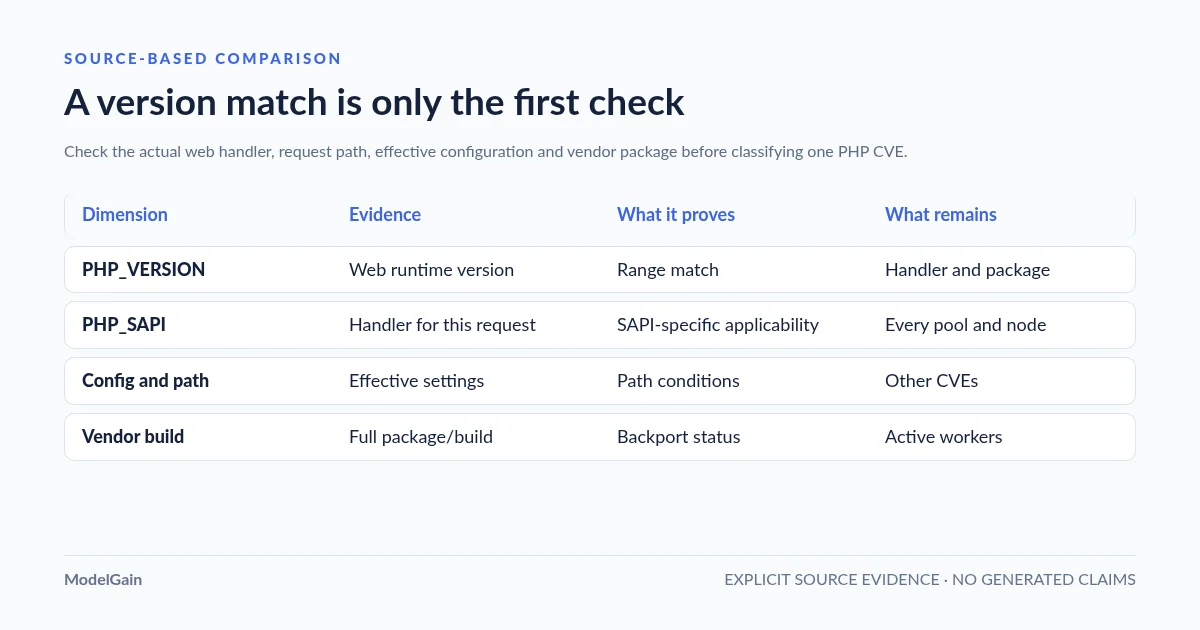
An upstream affected-version range answers one question: does the reported version fall inside the range named by the advisory? It does not, by itself, establish which PHP binary serves the domain, whether the vulnerable request path is reachable, whether a required setting is enabled, or whether the host has backported the fix into a vendor package.
- PHP_VERSION: establishes the version reported by the PHP runtime serving this request. It does not establish the SAPI, package provenance, configuration, request mapping or exploitability.
- PHP_SAPI / handler: identifies the interface serving this request. It does not prove every domain, pool, node or worker uses the same handler.
- Configuration and request path: establish whether the advisory’s required setting, connection behavior or input path exists. They do not show whether the installed package already contains a vendor backport.
- Package and vendor advisory: establish whether the exact installed build contains the fix for this CVE. They do not prove every running worker has loaded that package.
- Exploitability: depends on the complete prerequisites and reachable path for this specific issue. Another CVE in the same PHP branch can have different prerequisites.
Keep these questions separate. A host can have a genuine upstream version match but not run the affected SAPI. A vendor can also backport a fix while retaining an older upstream version string. Those are different findings and need different evidence.
CVE-2026-129538: PHP-CGI is not PHP-FPM
The PHP project’s CVE-2026-129538 advisory, published on 19 November 2026, describes an out-of-bounds read and write in the PHP-CGI binary. It applies to CGI and PHP-CGI FastCGI mode when cgi.fix_pathinfo is enabled, which is the default. The vulnerable condition also requires a web-server mapping that passes inconsistent path values, or a FastCGI listener that an untrusted client can reach.
The path problem occurs when PHP removes a suffix from SCRIPT_FILENAME or PATH_TRANSLATED that is longer than the supplied PATH_INFO, or when PATH_INFO is empty. A normal rewrite rule, by itself, does not prove that this condition exists.
The official advisory explicitly says PHP-FPM and the Apache PHP module are not affected by this CVE. This distinction is easy to miss because PHP-FPM and PHP-CGI can both communicate with a web server over FastCGI. They are not the same PHP handler.
fpm-fcgiidentifies the PHP-FPM SAPI.apache2handleridentifies PHP running as an Apache module.cgi-fcgiidentifies the CGI/FastCGI interface, but the host still needs to confirm whether the actual executable isphp-cgior another FastCGI-managed PHP runtime. The word “FastCGI” alone does not distinguish PHP-CGI from PHP-FPM.
If the WordPress request is served by PHP-FPM or the Apache module, CVE-2026-129538 does not apply to that observed runtime. If it is served by PHP-CGI, check the effective cgi.fix_pathinfo value, the complete SCRIPT_FILENAME/PATH_INFO mapping, and whether the FastCGI listener is reachable only from trusted front ends. If the domain uses multiple pools, nodes or handlers, check each one.
The impact must also be described accurately. The advisory documents process crashes, possible memory disclosure when the application exposes PATH_INFO or PATH_TRANSLATED, and memory corruption. The PHP project rates it CVSS v4.0 6.9 (Medium); code execution has been claimed but was not confirmed in the upstream advisory. Do not turn this into an unverified “remote code execution” headline.
The upstream affected ranges listed for this advisory are PHP 8.2 before 8.2.36, PHP 8.3 before 8.3.37, PHP 8.4 before 8.4.28, and PHP 8.5 before 8.5.13. Those ranges identify the builds to review; the PHP-CGI handler and path prerequisites still determine whether this specific issue applies to the site.
The advisory’s affected-version ranges also extend below the currently maintained branches. PHP 8.1 and earlier no longer receive upstream fixes, so an older version is not cleared simply because it is absent from the maintained-branch release table. Ask the distribution or hosting provider for a CVE-specific backport notice and plan a move to a supported PHP branch. Do not assume an upstream fixed release exists for an end-of-life branch.
PHP-FPM is not a universal exemption: CVE-2026-129289
A separate PHP-FPM advisory demonstrates why the previous result cannot be generalized. CVE-2026-129289 describes request smuggling through an unread request body on a persistent FastCGI connection.
The demonstrated PHP-FPM path requires backend connection reuse—for example, nginx fastcgi_keep_conn on or Apache mod_proxy_fcgi with enablereuse=on—and an application path that opens php://input but does not consume the body before the request finishes. The remaining bytes can then interfere with a later request on the reused connection.
The upstream advisory says standard nginx and Apache configurations that close the FastCGI connection after each request are not affected by this demonstrated path. That is not a blanket exemption for every FPM deployment: custom proxy settings and application code can change the conditions. The advisory also describes a different request-desynchronization impact for LSAPI; do not copy the PHP-FPM code-execution claim to LSAPI.
The practical lesson is simple: FPM excludes CVE-2026-129538, but FPM-specific advisories such as CVE-2026-129289 still need their own checks. One CVE’s SAPI boundary is not a security verdict for the whole server.
The PHP project traces this request-cleanup defect back to PHP 5.6.0. The fixed releases in the table below cover the maintained 8.2–8.5 branches; PHP 8.1 and earlier require a vendor-specific backport decision or migration to a supported branch. Red Hat’s bulletin also documents the mitigation boundary: disable backend connection reuse on the affected front end until the fixed package is deployed, and do not expose PHP-FPM or LSAPI listeners directly to untrusted networks. Reading php://input fully is not a dependable sole mitigation across error and shutdown paths.
Session settings are another separate boundary
CVE-2026-115560 is a useful contrast. Its documented path involves session upload progress and inconsistent session serializers—for example, one application writes a shared session using php_binary or php_serialize while another reads the same session using php. The same session data must be accessible through the shared session store, and a suitable object gadget is required for the described code-execution path.
The fixed upstream branches change the compiled default for session.upload_progress.enabled to disabled, and prevent runtime changes to session settings while upload progress is enabled. An explicit host configuration can still enable the feature, so check the effective value in the web handler rather than relying on a sample configuration file or a CLI result. The upstream advisory also notes that older unsupported releases may be affected because session upload progress was introduced in PHP 5.4.
If upload progress is explicitly enabled, the upstream advisory requires matching session.serialize_handler values across all readers and writers that can access the same session store. Check php.ini, FPM pools, virtual hosts, application overrides and command-line jobs. Setting session.upload_progress.enabled=0 administratively before request input is processed removes the upload-progress path; an application-level ini_set() is too late. This is a CVE-2026-115560 mitigation, not a general PHP session-security fix.
Do not turn that one setting into a universal all-clear. CVE-2026-126714 concerns the default file-based session handler and its own session-content and interrupted-write prerequisites; the upstream advisory says the issue is not limited to session upload progress.
Which upstream PHP versions contain the November fixes?
The PHP project released the following security updates on 19 November 2026. These are upstream release versions for the maintained branches listed by the advisories; a hosting provider may deliver a backported fix in a differently numbered package.
- PHP 8.2 — 8.2.36: official security release.
- PHP 8.3 — 8.3.37: official security release.
- PHP 8.4 — 8.4.28: official security release.
- PHP 8.5 — 8.5.13: official security release.
For a host-managed build, compare the complete installed package/build with the vendor’s notice for the exact CVE. A version such as 8.4.27 in WordPress does not prove that an Ubuntu, CloudLinux or cPanel package is missing a backport; equally, a provider saying “patched” is not evidence until the package and active worker are identified. See our separate guide to vendor backports and PHP version warnings.
Older unsupported PHP branches need a separate vendor decision and upgrade plan. Do not assume that an upstream fixed release exists for a branch that no longer receives upstream security updates. If your branch is already end-of-life, see our guide to PHP end-of-life and hosting extended support.
How to verify the actual WordPress runtime
- Record the web runtime. Use WordPress Site Health or an administrator diagnostic that runs through the affected domain. Record
PHP_VERSIONandPHP_SAPI, with the time checked. - Do not substitute the CLI binary.
php -vandphp -imay describe a command-line PHP installation, not the PHP handler serving WordPress. A load-balanced site may also have more than one web runtime. - Identify the actual process. Ask the host whether the domain is served by PHP-FPM, PHP-CGI, an Apache module or LSAPI. If it is FastCGI, confirm whether the binary is PHP-CGI or PHP-FPM.
- Check only the prerequisites named by the advisory. For CVE-2026-129538, inspect the effective
cgi.fix_pathinfovalue, path mapping and FastCGI listener boundary. For CVE-2026-129289, inspect connection reuse and the reachable application path that readsphp://input. - Verify the package and loaded workers. Obtain the full vendor package/build and the vendor security notice for the CVE. Confirm that all relevant PHP workers have restarted onto the fixed build.
- Keep the result CVE-specific. Record which exact prerequisite is present or absent. Recheck other advisories independently; do not use one CVE’s exclusion to clear the entire PHP branch.
Do not leave a public phpinfo() page or diagnostic endpoint online. If you cannot see the effective web configuration, ask the hosting provider to verify it for the exact domain and PHP pool.
Use four outcomes instead of guessing “safe” or “vulnerable”
- Fixed and loaded: the exact vendor package/build contains the fix and the active workers are confirmed on it.
- Not applicable to this CVE: the advisory explicitly excludes the observed handler, or a required condition is proven absent. Keep the conclusion limited to that CVE and runtime.
- Potentially exposed: the version range matches and the required handler/configuration/request path is present. Prioritize the vendor’s fixed release.
- Unknown: the handler, effective configuration, package or request path cannot be verified. Ask the host; missing evidence is not a clean result.
Check a PHP CVE against the actual host
Applies when: A PHP version-range alert matches the domain, but the advisory may require a particular SAPI, request mapping, configuration or package state. This check is per CVE and per runtime; it does not replace patching.
Quick answer
A version match is a potential finding, not proof of exploitability. Identify the PHP handler serving the domain, verify the exact prerequisites in the upstream advisory, and confirm the vendor package and active workers. If any evidence is missing, keep the result unknown and ask the host. Continue with the fixed release rather than waiting for proof of exploitation.
What to do
-
Capture PHP_VERSION and PHP_SAPI from the affected WordPress domain. Do not substitute php -v from the command line, and check every pool or node in a load-balanced deployment.
-
Write down the affected version range, SAPI, request path, required settings, impact and fixed upstream release. Do not reuse one CVE's exclusion for another advisory.
-
For PHP-CGI, check cgi.fix_pathinfo, SCRIPT_FILENAME/PATH_INFO mapping and FastCGI listener reachability. For PHP-FPM, check connection reuse and whether the application can leave request-body bytes unread. For session issues, check the effective settings for every relevant pool.
-
Ask the host for the complete vendor package/build and the exact CVE-specific vendor notice. Confirm that all relevant PHP workers have restarted onto the fixed package.
Which evidence do you have for the exact domain and CVE?
All paths are listed below. Select a symptom to focus on the most relevant path.
Fixed and loaded
Record the full vendor package/build, the CVE-specific vendor notice and the worker restart/readback. Recheck other CVEs independently; one fixed package or one SAPI exclusion does not clear the entire PHP branch.
Not affected by CVE-2026-129538 on this observed handler
The upstream CVE-2026-129538 advisory explicitly excludes PHP-FPM and the Apache PHP module. Keep this conclusion limited to that CVE and the domain/pool you checked. PHP-FPM can still be affected by other advisories, including CVE-2026-129289.
Potential PHP-CGI exposure
For CVE-2026-129538, verify the actual PHP-CGI binary, cgi.fix_pathinfo, the SCRIPT_FILENAME/PATH_INFO mapping and FastCGI listener boundary. Install the fixed vendor package and restart all relevant workers; do not wait for a proof of exploitation.
Potential PHP-FPM request-smuggling exposure
For CVE-2026-129289, confirm persistent FastCGI connection reuse and an application path that leaves request-body bytes unread. If both are present, prioritize the fixed package. If either is unknown, ask the host rather than assuming the default configuration.
Potential session-configuration exposure
For CVE-2026-115560, verify session.upload_progress.enabled and whether applications or pools with different session serializers share the same session data. Install the fixed package. Disabling upload progress is not a global mitigation for other session CVEs such as CVE-2026-126714.
Unknown — request host evidence
Missing evidence is not a clean result. Send the host the exact CVE ID, PHP_VERSION and PHP_SAPI, then request the actual handler, effective configuration, full package/build and confirmation that active workers have loaded the fix. Do not label the site safe and do not delay patching.
Did this help?
There is an important exception to remember: the October PHP2Shell advisories CVE-2026-109618 and CVE-2026-109619 were assessed across web-serving PHP configurations, including FPM, CGI and mod_php. The Government of Ireland NCSC advisory explicitly lists those different SAPIs. Do not transfer the narrow PHP-CGI exclusion from CVE-2026-129538 to those different vulnerabilities.
What to ask your hosting provider
Our WordPress web request reports PHP [version] and SAPI [value] for [domain]. Please confirm the actual PHP binary/handler and full installed package/build for this domain and every relevant worker.
For CVE-2026-129538, please confirm whether PHP-CGI is used, the effective
cgi.fix_pathinfosetting, theSCRIPT_FILENAME/PATH_INFOmapping, and whether an untrusted client can reach the FastCGI listener.For CVE-2026-129289, please confirm whether FastCGI backend connection reuse is enabled and whether the application path can leave request-body bytes unread. Please identify the vendor package/build containing the fix and confirm that the active workers have loaded it.
Please include the relevant vendor security notice or package changelog. No credentials or API tokens are required.
What PHP Security Monitor can—and cannot—confirm
ModelGain PHP Security Monitor provides a useful first evidence layer. Its published WordPress plugin reads the actual PHP_VERSION and PHP_SAPI serving the administrator request, retrieves the optional PHP vulnerability feed after consent, and compares the reported version with the feed’s version ranges. It can show potential matches and provide a timestamped report for your host.
It does not inspect nginx or Apache routing, prove the active FastCGI binary, read every PHP-FPM pool, inspect session or upload settings, enumerate extensions, verify OS package backports, or prove that a CVE can—or cannot—be exploited. The current matcher is version-based; the displayed SAPI is context for the administrator’s investigation, not an automatic per-CVE exploitability verdict. A potential match is a reason to verify and patch, not a confirmed exploit diagnosis.
Install it from the official WordPress.org listing or review the PHP Security Monitor product details. For the broader alert workflow, see how to verify a WordPress PHP vulnerability alert. For package-level backports, use the vendor patch verification guide.
Primary advisories and related reading
- PHP upstream: CVE-2026-129538 (PHP-CGI PATH_INFO handling)
- PHP upstream: CVE-2026-129289 (PHP-FPM request smuggling)
- PHP upstream: CVE-2026-115560 (session serializer mismatch)
- PHP upstream: CVE-2026-126714 (file-based session handler)
- PHP upstream: CVE-2026-109618 (PHP2Shell) · CVE-2026-109619
- PHP supported versions and lifecycle dates
- PHP manual: identifying the active SAPI
- Community example: checking FastCGI connection reuse for CVE-2026-129289 · maintainer’s configuration readback
- Community discussion: PHP session upload-progress exposure (23 October preliminary notice; use the full 19 November upstream advisory for current conditions)
Community reports are useful for finding the questions operators are asking, but an individual project’s configuration is not proof about another host. Use the upstream advisory and your own package/configuration evidence for the final decision.